Beyond the Horizon: Two Future Health IT Trends That Will Reshape U.S. Healthcare
- ruzenellorico
- May 23
- 6 min read
Simulating Survival: How Digital Twins and Quantum Computing Will Rewrite the Economics of Healthcare
The Hook: A Rehearsal for Reality
We have reached an extraordinary inflection point in American healthcare. The U.S. currently spends approximately $4.9 trillion annually—a staggering 17.6% of GDP—yet we consistently rank below peer nations in major population health outcomes. For years, we have optimized the periphery with Electronic Health Records (EHRs) and telehealth. Today, however, a new generation of tools is emerging from research labs that promises to fix the core inefficiency of the system: the "average" patient model.
For too long, medicine has been reactive, generalized, and expensive. Patients are frequently treated based on what works for a statistical mean, leading to a "trial-and-error" approach that is often physically devastating and fiscally unsustainable. We are finally moving beyond this.
Two transformative trends—Personal Digital Twins (PDTs) and Quantum-Powered Drug Discovery—are transitioning from proof-of-concept to clinical reality. These are the tools that will allow us to move from a system that responds to illness to one that anticipates and rehearses intervention in a virtual environment before a single drop of medicine touches a patient.
--------------------------------------------------------------------------------
Takeaway 1: The Personal Digital Twin – Your Virtual Biological Body Double
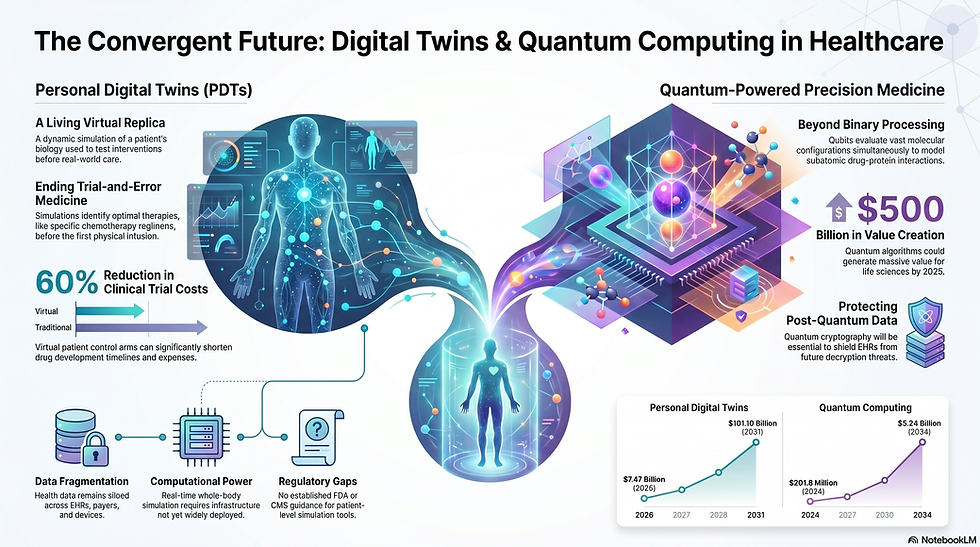
The Concept A Personal Digital Twin (PDT) is a dynamic, virtual replica of an individual patient. It is built by integrating a vast array of data points: genetic profiles, EHR history, real-time wearable sensor streams, and social determinants of health. This follows a proven industrial engineering logic: just as manufacturers simulate aircraft engines or power plants to predict failure before it happens, healthcare providers can now simulate a specific person’s biology to test interventions with total precision.
The Analysis This technology marks the definitive end of "trial-and-error" medicine. In oncology, for instance, a patient might currently endure multiple rounds of ineffective, toxic chemotherapy. With a PDT, clinicians can simulate different regimens against the patient’s specific tumor genome and physiology to identify the optimal therapy first. The strategic ROI is immense: in silico clinical trials, which use virtual patients to supplement real-world control arms, are projected to cut trial costs by 60% and shorten development timelines by 40%.
The Impact Beyond the lab, PDTs offer a way to democratize specialist-level insight. In rural America, where hospital closures have left patients miles from expert care, a digital twin could allow a primary care physician to access diagnostic pathways previously only available at top-tier academic medical centers, closing critical gaps in health equity.
"The moonshot is to create and maintain a digital twin for every individual — part of their personal medical records, continuously updated, used to optimize care and evaluate new medical technologies." — Dr. Ehsan Samei, Director, Duke Center for Virtual Imaging Trials
--------------------------------------------------------------------------------
Takeaway 2: Why Your Digital Twin Isn't Here (Yet)
While we currently possess organ-level models and hospital operational twins, a persistent, whole-person digital twin is not yet available at scale. Five primary barriers must be addressed by healthcare leaders:
Data Fragmentation: Health data remains siloed across disparate EHR systems, payers, and devices; we lack a universal longitudinal patient record.
Computational Requirements: Simulating the full, multi-system complexity of a living human in real time requires massive infrastructure not yet widely deployed in clinical settings.
Regulatory Gaps: Federal agencies like the FDA and CMS have yet to establish formal guidance for the use of patient-level simulation tools in clinical decision-making.
Ownership and Ethics: Unresolved questions persist regarding who owns a patient’s digital twin and how data privacy and consent will be managed in a simulation-heavy era.
Model Fidelity: While AI is excellent at modeling specific diseases, capturing the total interaction of every human biological system remains a frontier challenge.
--------------------------------------------------------------------------------
Takeaway 3: Quantum Computing – Cracking the Subatomic Code
The Concept Classical computers use binary bits (0s and 1s). Quantum computers use "qubits," which leverage superposition and entanglement to evaluate an astronomical number of configurations simultaneously. Why does this matter for medicine? Because the binding of a drug molecule to a protein is governed by quantum-level physics. Classical computers rely on imprecise approximations, which is a primary reason 90% of drug candidates fail in clinical trials. Quantum computers can model these interactions at the subatomic level with absolute accuracy.
The Impact We are already seeing breakthroughs that were previously considered impossible. St. Jude Children’s Research Hospital recently identified drug candidates for the "undruggable" KRAS protein—a target linked to 25% of all human cancers. Meanwhile, IBM and Moderna have utilized quantum-classical hybrids to simulate mRNA sequences. This isn't just a marginal improvement; it's a phase shift.
The Analysis The institutional confidence in this technology is clear. According to a McKinsey survey, 72% of tech executives, investors, and academics believe fault-tolerant quantum computing will arrive by 2035. For the life sciences, this represents a massive value-creation opportunity.
"Quantum computing is poised to transform the life sciences industry; McKinsey estimates potential value creation of $200 billion to $500 billion by 2035." — McKinsey & Company
--------------------------------------------------------------------------------
Takeaway 4: The Convergence – A Predictive Powerhouse
Personal Digital Twins and Quantum Computing are convergent futures. While PDTs provide the longitudinal data required for personalized medicine, they will eventually require the subatomic processing power of quantum computing to simulate full-body physiology and molecular drug interactions in real time.
Institutional Confidence The market is already pricing in this transition. The healthcare digital twin market is projected to skyrocket from $7.47 billion in 2026 to $101.19 billion by 2031. Similarly, the quantum healthcare market is expected to reach $5.24 billion by 2034. As these technologies mature, "Post-Quantum Cryptography" will become a mandatory defense, using quantum principles to protect the massive biological datasets these systems require.
--------------------------------------------------------------------------------
Conclusion: Moving the Needle from Reactive to Proactive
The integration of Personal Digital Twins and Quantum Computing represents more than a technological upgrade; it is a mandatory pivot for a U.S. healthcare system that is currently expensive and unsustainable. By shifting from generalized treatments to molecular-level precision, we can finally move the needle toward a system that anticipates and prevents illness rather than merely responding to its damage.
The challenge for health IT leaders today is to build the data infrastructure, governance frameworks, and ethical guardrails needed to support this transition. As we enter this era, we must confront a fundamental question: as our biological data becomes our most valuable asset, how will we ensure that every individual maintains ownership and control over their virtual double?
References
Columbia Data Science Institute. (2026, April 26). Digital twins in health care: Clinical, ethical and legal perspectives. https://datascience.columbia.edu/event/digital-twins-in-health-care-clinical-ethical-and-legal-perspectives/
Duke Center for Virtual Imaging Trials (CVIT). (2025). The future of in silico trials and digital twins in medicine. https://cvit.duke.edu/news/the-future-of-in-silico-trials-and-digital-twins-in-medicine/
Exploration Publishing. (2026, January 13). Towards the future of personalized medicine: Digital twin technology. https://www.explorationpub.com/Journals/edht/Article/101181
Grand View Research. (2025). Healthcare digital twins market size & industry report, 2030. https://www.grandviewresearch.com/industry-analysis/healthcare-digital-twins-market-report
IBM. (2020). Exploring quantum computing use cases for healthcare. https://www.ibm.com/thought-leadership/institute-business-value/en-us/report/quantum-healthcare
IQVIA. (2025, June 29). Digital twins in healthcare: Unlocking the future of personalized medicine and diagnostics. https://www.iqvia.com/library/white-papers/digital-twins-in-healthcare
Kaul, V., et al. (2024, May 12). Envisioning the future of personalized medicine: Role and realities of digital twins. JMIR. https://www.jmir.org/2024/1/e50204/
LinkedIn / McKinsey Survey Summary. (2025, November 16). McKinsey: 72% of tech executives say fault-tolerant quantum computer could arrive by 2035. https://www.linkedin.com/posts/kent-walker-5963bb198_mckinsey-said-72-of-the-tech-executives-activity-7396072031420801024-Vzmi
Market.us. (2025, August 21). Quantum computing in healthcare market — size, CAGR of 38.5%. https://market.us/report/quantum-computing-in-healthcare-market/
MarketsandMarkets. (2026). Digital twins in healthcare market — $7.47B to $101.19B by 2031. https://www.marketsandmarkets.com/Market-Reports/digital-twins-in-healthcare-market-74014375.html
MarketsandMarkets. (2025). Quantum computing in healthcare market report 2025–2030. https://www.marketsandmarkets.com/Market-Reports/quantum-computing-in-healthcare-market-41524710.html
McKinsey & Company. (2025, August 24). The quantum revolution in pharma: Faster, smarter, and more precise. https://www.mckinsey.com/industries/life-sciences/our-insights/the-quantum-revolution-in-pharma-faster-smarter-and-more-precise
McKinsey & Company. (2024). What is quantum computing? https://www.mckinsey.com/featured-insights/mckinsey-explainers/what-is-quantum-computing
MIT Sloan Management Review. (2024, January 10). Quantum computing: What leaders need to know now. https://mitsloan.mit.edu/ideas-made-to-matter/quantum-computing-what-leaders-need-to-know-now
Nature (npj Digital Medicine). (2024, March 21). Digital twins for health: A scoping review. https://www.nature.com/articles/s41746-024-01073-0
Nature. (2026, January 6). Quantum-machine-assisted drug discovery. https://www.nature.com/articles/s44386-025-00033-2
Nature (npj Precision Oncology). (2025, December 2). Quantum computing and the implementation of precision medicine. https://www.nature.com/articles/s41525-025-00537-w
NextMSC. (2026, January 21). Digital twin in healthcare market trends: 2030 insights. https://www.nextmsc.com/report/digital-twins-in-healthcare-market
PHG Foundation. (2026, April 27). Quantum computing: The future of healthcare in the UK? https://www.phgfoundation.org/long-read/quantum-computing-the-future-of-healthcare-in-the-uk/
PMC / NIH. (2025, August 6). Digital twin for personalized medicine development. https://pmc.ncbi.nlm.nih.gov/articles/PMC12369496/
PMC / NIH. (2025, October 21). Digital twins in personalized medicine: Bridging innovation and practice. https://pmc.ncbi.nlm.nih.gov/articles/PMC12653454/
PMC / NIH. (2025, April 21). The potential role of quantum computing in biomedicine and healthcare. https://pmc.ncbi.nlm.nih.gov/articles/PMC12096140/
ScienceDirect. (2025). Digital twin technologies in medicine: Innovations, barriers, and future directions. https://www.sciencedirect.com/science/article/pii/S3050837125000438
St. Jude Children's Research Hospital. (2025, April 2). Quantum computing makes waves in drug discovery. https://www.stjude.org/research/progress/2025/quantum-computing-makes-waves-in-drug-discovery.html
World Economic Forum. (2025, January 2). How quantum computing is changing molecular drug development. https://www.weforum.org/stories/2025/01/quantum-computing-drug-development/
ZS Associates. (2026, April 6). Reimagining clinical trials with in silico and AI-driven methods. https://www.zs.com/insights/true-value-potential-in-silico-clinical-development
🤖 AI Use Acknowledgment: This blog post was researched and drafted with the assistance of Perplexity AI, serving as an orchestrating AI research assistant — retrieving and synthesizing peer-reviewed literature, market research reports, McKinsey analysis, and expert perspectives from Nature, MIT Sloan, World Economic Forum, NIH/PMC, MarketsandMarkets, St. Jude Children's Research Hospital, and IQVIA MedTech. The author directed the research inquiry, selected and framed the two future trends, and provided editorial narrative. All three visuals were AI-generated using Perplexity's image generation tools to complement the research. This blog is an example of AI-empowered academic and professional content creation: using AI not to replace human judgment, but to amplify research depth, citation accuracy, and visual storytelling.
📍 Posted to HealthTech Discovery Lab | health-it-sim-lab.weebly.com


Comments